Tradition And The Church by George Agius
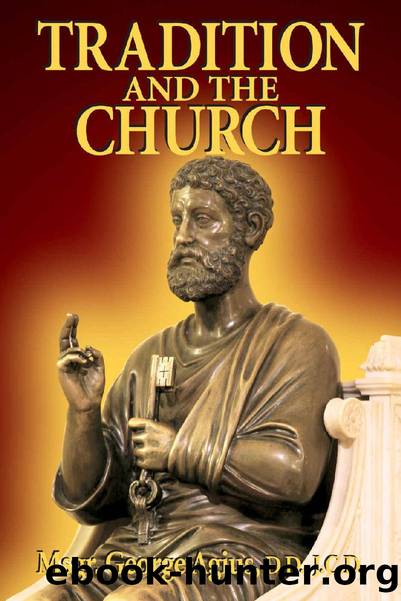
Author:George Agius [Agius, George]
Language: eng
Format: epub
Publisher: TAN Books
Published: 2016-03-30T06:00:00+00:00
3
The Canon or Rule of St. Vincent of Lerin is True In an Affirmative, Not in an Exclusive Sense. It is Simply the Way to Find Out the Apostolicity of a Certain Doctrine in Order to Repel Novelty.
Famous among the writings of the Fathers is the Canon of Vincentius, or as others call him, St. Vincent of Lerin (c.400-c.450). Contained in his Commonitorium, the Canon draws a line, intended to discern what is pure from what is corrupt, to distinguish the truth from what is simply an opinion, to determine what is orthodox from what is faulty. "We must hold what has been held always, everywhere, and by all; this is truly and properly Catholic . . . this can be obtained if we follow universality, antiquity, consent." (N. 3, Emphasis added). These are the three characteristic notes of the so-called Vincentian Canon or Rule.
There is nothing in this world however, which may not be abused. For this reason, in order to cut off as corruptions all usages, tenets and dogmas which are not sanctioned by primitive times, Protestants appeal to this rule, by which they strike at Rome, never thinking that it is an assault against Protestantism itself. Cardinal Newman, in the last book which he wrote before he became a convert to the Catholic Church, speaking of this rule and proving that "scanty as the Ante-Nicene notices may be of Papal Supremacy, they are both more numerous and more definite than the adducible testimonies in favor of the Real Presence," and adducing himself as a believer in the Real Presence, he exclaims: "I betake to one of our altars to receive the Blessed Eucharist; I have no doubt whatever on my mind about the Gift which that Sacrament contains . . . the Presence of Christ is here, for it follows upon Consecration; and Consecration is the prerogative of priests; and priests are made by Ordination; and Ordination comes in direct line from the Apostles . . . therefore, we are blessed with the great Gift. Here the question rises in me: who told you about that Gift? I answer: I have learned it from the Fathers: I believe the Real Presence because they bear witness to it . . . and then the thought comes upon me a second time: and do not the same ancient Fathers bear witness to another doctrine (Papal Supremacy), which you disown? Are you not as a hypocrite, listening to them when you will, and deaf when you will not? How are you casting your lot with the Saints when you go but halfway with them? For, of whether [i.e., which] of the two do they speak the more frequently, of the Real Presence or of the Pope's Supremacy? You accept the lesser evidence, you reject the greater."3 Then he proceeds to show the contradiction of his Episcopalian brethren when they discard many truths and practices of the Catholic Church because they were not believed or practiced "always, everywhere, and by all,"
Download
This site does not store any files on its server. We only index and link to content provided by other sites. Please contact the content providers to delete copyright contents if any and email us, we'll remove relevant links or contents immediately.
Plagued by Fire by Paul Hendrickson(17524)
The 5 Love Languages: The Secret to Love That Lasts by Gary Chapman(9996)
How to Bang a Billionaire by Alexis Hall(8261)
Wonder by R. J. Palacio(8221)
The Institute by Stephen King(7144)
The Thirst by Nesbo Jo(7082)
The Testaments by Margaret Atwood(7076)
The Space Between by Michelle L. Teichman(7022)
Assassin’s Fate by Robin Hobb(6358)
Wiseguy by Nicholas Pileggi(5918)
Spare by Prince Harry The Duke of Sussex(5345)
The Night Circus by Erin Morgenstern(5343)
The MacArthur Bible Commentary by John MacArthur(4948)
Bittersweet (True North #1) by Sarina Bowen(4912)
Tuesdays with Morrie by Mitch Albom(4903)
Everything Happens for a Reason by Kate Bowler(4830)
Gerald's Game by Stephen King(4784)
The Templars by Dan Jones(4772)
From Sand and Ash by Amy Harmon(4658)
